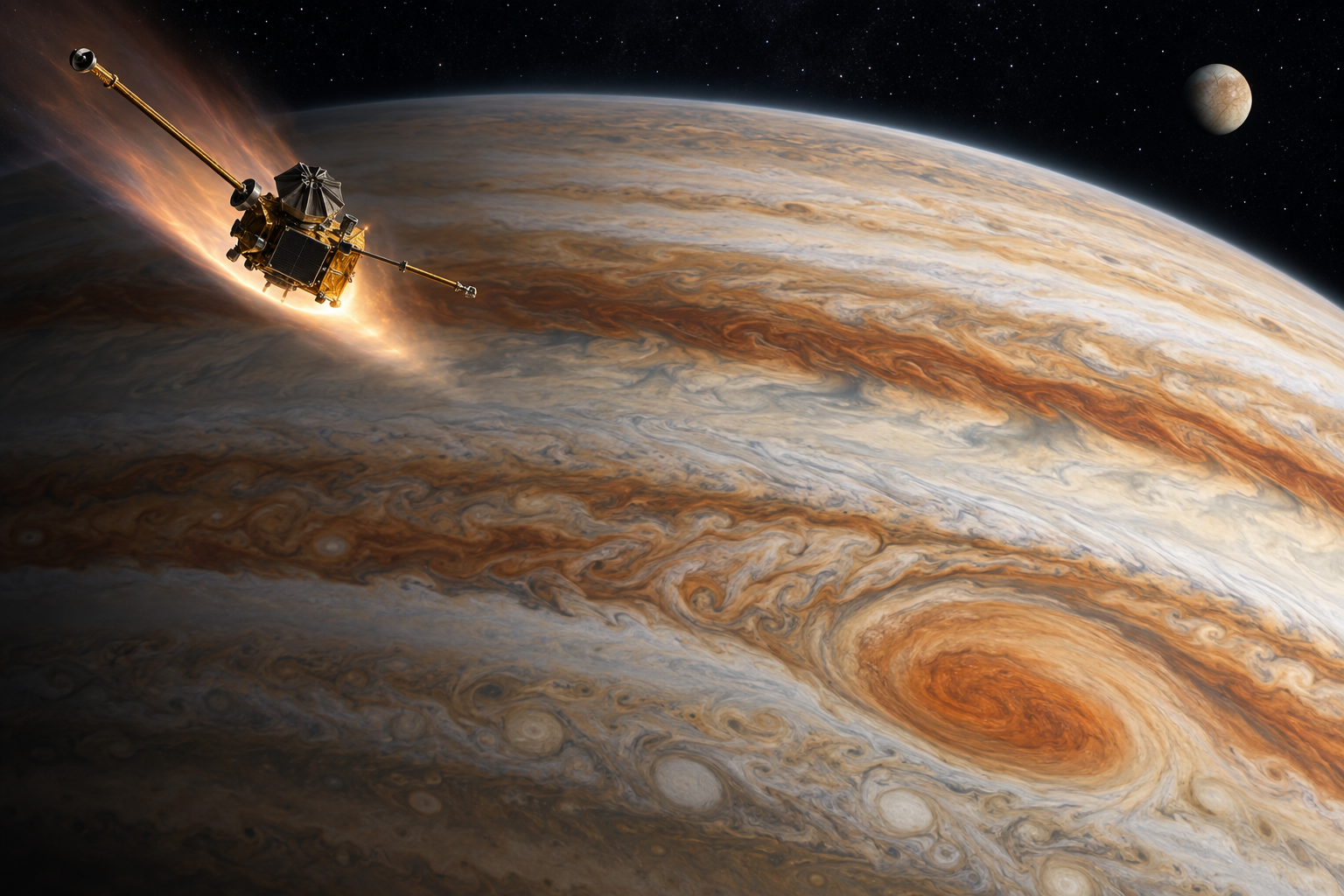
The popular version says NASA crashed a spacecraft to protect “alien life.” That skips one crucial distinction. Galileo did not find organisms, fish, or even a confirmed habitable ecosystem. It found evidence that liquid water may exist beneath Europa’s ice. That possibility was enough to change what responsible disposal looked like.
Galileo was launched from space shuttle Atlantis on October 18, 1989. A direct trip to Jupiter was not available to the mission, so the spacecraft used gravity assists at Venus and twice at Earth before arriving in December 1995. It became the first spacecraft to orbit an outer planet and released a separate probe into Jupiter’s atmosphere.
The mission succeeded with its main antenna stuck shut
Galileo’s most famous engineering failure happened before Jupiter. Its umbrella-like high-gain antenna did not fully deploy in 1991. That antenna was supposed to carry the mission’s heavy stream of images and measurements home. The low-gain antenna that remained available could transmit only a fraction of the planned data rate.
The recovery was not a miraculous hardware repair. Engineers changed how the spacecraft used its tape recorder, rewrote flight and ground software, compressed data onboard, and made the communications system more efficient. NASA says those changes increased average telemetry capacity tenfold. The mission still lost some planned observations, but the salvage effort is part of the accomplishment—not a footnote that should disappear behind a list of discoveries.
Europa made an ordinary disposal problem ethically sharper
Galileo’s magnetometer and imaging results strengthened the case for a salty ocean beneath Europa’s fractured ice. That did not make contamination likely. It made the consequences of an avoidable collision harder to dismiss. The spacecraft had not been sterilized to the standards expected for hardware intended to contact a world of astrobiological interest.
Meanwhile, the propellant used to control Galileo’s orientation and trajectory was running out. Without it, the craft could eventually stop pointing its antenna toward Earth and could no longer reliably correct its orbit. Mission managers therefore chose a destination with no solid surface to contaminate: Jupiter’s crushing atmosphere.
This is forward contamination in plain language. A terrestrial microbe carried into an extraterrestrial environment might compromise future life-detection experiments, or in a worst case interfere with an environment science has barely begun to understand. Modern Europa missions face stricter cleanliness requirements; NASA describes Europa orbiters as Planetary Protection Category III.
The final signal arrived after the spacecraft was gone
Galileo crossed into Jupiter’s atmosphere just south of the equator at about 30 miles per second. The spacecraft continued returning measurements during the approach. JPL recorded the end at 11:57 a.m. Pacific time; the Deep Space Network received the final signal at 12:43:14 p.m. The apparent delay was not hesitation in the maneuver. Radio waves needed roughly fifty minutes to cross the distance to Earth.
By then Galileo had traveled about 2.8 billion miles, spent nearly eight years at Jupiter, and survived more than four times the cumulative Jovian radiation dose for which it had been designed. Its record included the first close asteroid observations, the discovery that asteroid Ida has a small moon, direct observation of comet Shoemaker–Levy 9’s impact on Jupiter, volcanic activity at Io, and a magnetic field generated by Ganymede.
A good ending can be part of the engineering
The useful lesson is not that spacecraft should be destroyed dramatically. It is that end-of-life behavior belongs in a system’s design. A machine can complete its primary job and still create risk if nobody has reserved enough control to put it somewhere safe.
Galileo’s end also resists the tidy language of triumph and failure. The antenna failed; the workarounds were excellent. The spacecraft made discoveries its designers could not fully anticipate; those discoveries narrowed the acceptable choices for disposal. The final maneuver sacrificed a functioning scientific instrument to protect the credibility of science that had not yet been done.
PRODUCT DIRECTION 01 · AMBIENT OBJECT
A planet lamp should create scale, not glare
The calendar suggests a Saturn or moon lamp. For a Galileo reading corner, the useful specification is not the most realistic surface print. Look for dimmable warm light, a stable base, replaceable or standard power, and a shade that hides individual LED points. A novelty lamp that is too bright to leave on has missed its only job.
Buying limit: We did not find an exact Amazon.com offer with a sufficiently clear seller, fulfillment, and U.S.-delivery chain today, so this remains a comparison direction rather than an affiliate recommendation.
Original editorial image, not a retailer or manufacturer product photo.PRODUCT DIRECTION 02 · READING PATH
Choose a planet book that explains evidence
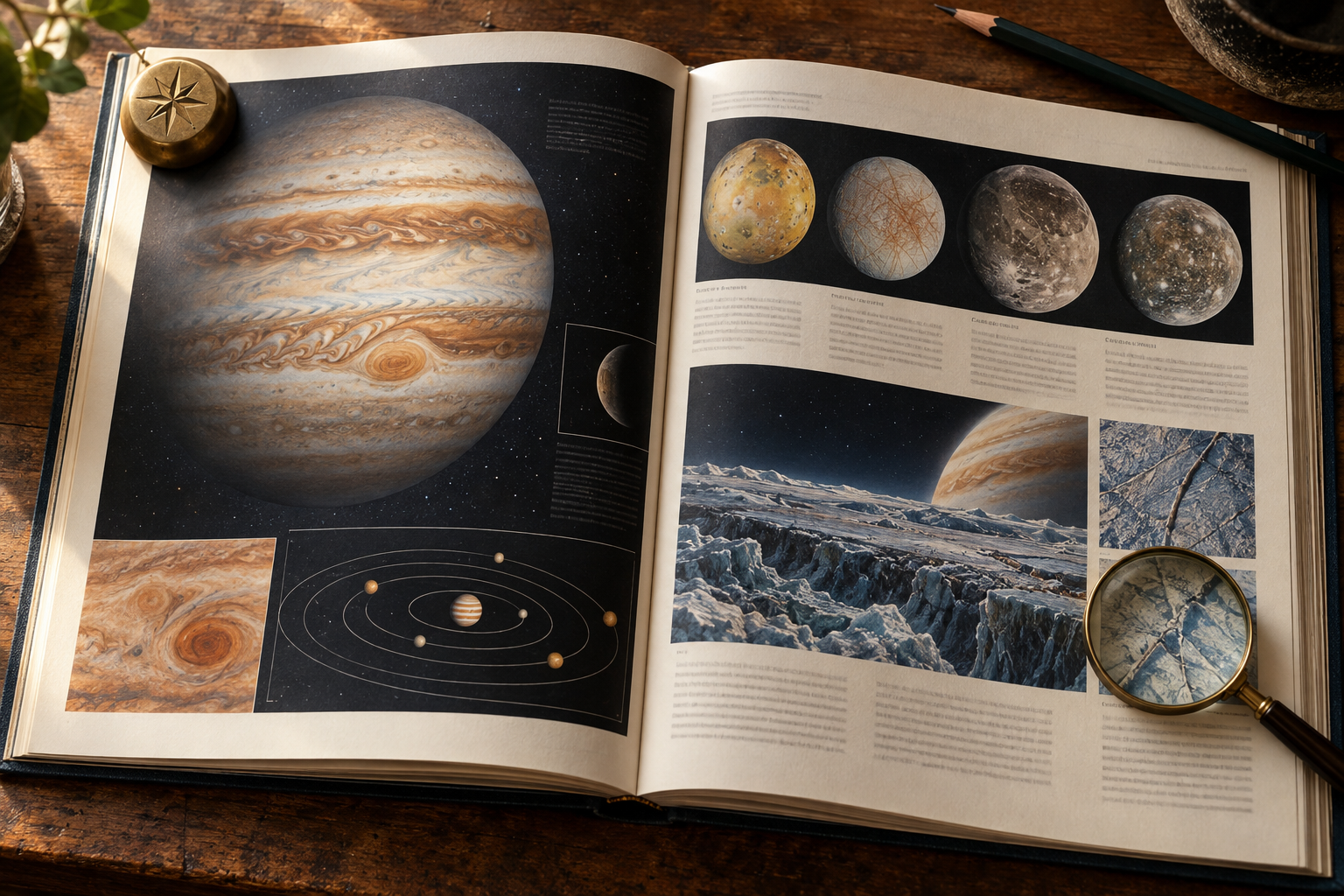
National Geographic publishes several children’s planet titles, but “Planets” is not one unambiguous edition. A useful book for this story should distinguish a discovery from an inference: Galileo measured magnetic fields and surface features; scientists used those observations to build the ocean case. Check the ISBN, reading age, publication date, and whether Jupiter’s moons receive more than a caption.
Buying limit: ISBN records identify multiple editions, but we could not verify a current exact Amazon offer and U.S. fulfillment today. No affiliate link is included.
Original editorial image; it does not reproduce a publisher’s cover or interior pages.FOUR QUESTIONS THAT CHANGE THE STORY
What the one-line anniversary leaves out
Why did NASA crash Galileo into Jupiter?
Its propellant was nearly exhausted. Once the spacecraft could no longer control its attitude and trajectory, it might eventually have struck Europa. Because Galileo was not sterilized for contact with a potentially habitable ocean world, NASA removed that risk while the spacecraft was still controllable.
Did Galileo discover life on Europa?
No. Its observations supplied strong evidence for a salty liquid-water ocean beneath Europa’s ice. An environment that might be habitable is not evidence that it is inhabited.
Was the final plunge an explosion?
No visible fireball was observed from Earth. Galileo entered Jupiter’s atmosphere at roughly 30 miles per second and was destroyed by heating and pressure while sending science data.
Why was Galileo still scientifically successful after its antenna failed?
Its high-gain antenna never fully opened, sharply limiting transmission capacity. Engineers rewrote onboard and ground software, used data compression, and relied on the low-gain antenna to recover much of the planned science.
SOURCES, METHOD, AND LIMITS
We based the chronology and mission results on NASA’s Galileo mission archive, JPL’s contemporaneous end-of-mission status report, and the original end-of-mission press kit. We checked the contamination rationale against NASA/JPL’s current explanation of Europa biological cleanliness and the current COSPAR planetary-protection policy. Product research was performed September 21, 2026. We did not hands-on test a lamp or book, and we found no exact Amazon offer that passed the site’s seller, fulfillment, and U.S.-delivery check; therefore neither module contains an affiliate link.
CONTINUE THE THREAD
Browse the technology-history archive →How a spacecraft can succeed without reaching space →Practical technology guides →